Anderson's Store
1Between 1875 and 1876, Anderson and Mowat established their first grain store on Harbour Street, placing it toward the rear of the section while planning for a more prominent frontage building to follow. This early structure was built in concrete, designed by John Lemon and constructed by F. Every, and was capable of storing approximately 40,000 bushels of grain.
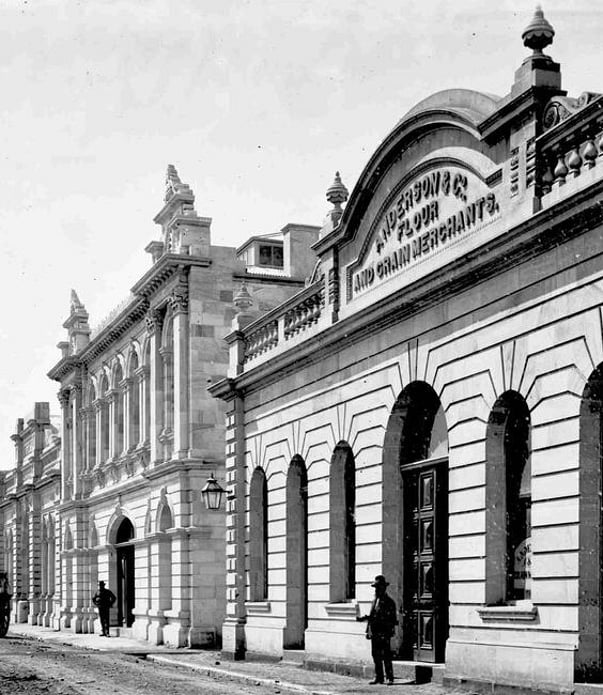
The partnership dissolved in March 1876, after which Anderson continued developing the site on his own. In 1877 he constructed a more substantial frontage building, likely erected by Dunedin contractor David McGill with stonework by H. Monro,
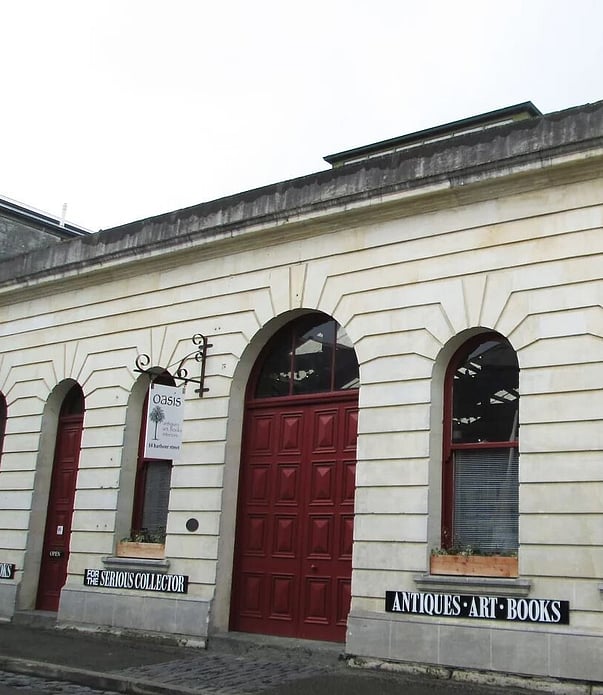
The North Otago Times described this later addition as a fine Italianate-style structure with a 60-foot (18m) Harbour Street frontage and a depth of 76 feet (23m). Built from Cave Valley stone in rusticated courses, it featured a grand central arched entrance, flanked by similar side openings, and was finished with a heavy cornice, balustraded parapet, and decorative urns. A central panel carried the name “Anderson and Co., Grain and Flour Merchants” in bold Roman lettering.
Internally, the building had 18-foot (5.4m) high walls, an open iron roof with trusses and lantern lighting, and concrete floors designed for heavy storage use. Two offices occupied the Harbour Street end, and the combined store length reached around 127 feet (40m), with capacity for approximately 30,000 grain sacks.
In 1881, Anderson and Co. expanded further by installing a flour mill called the Red Lion within the complex,
This was the site of the first hydro electric power on Harbour Street, powered by a turbine wheel connected to the municipal water system and capable of driving six millstones. Just two years later, in 1883, the property was sold to Gray and Aldrich, who renamed it the Red Lion Mill,
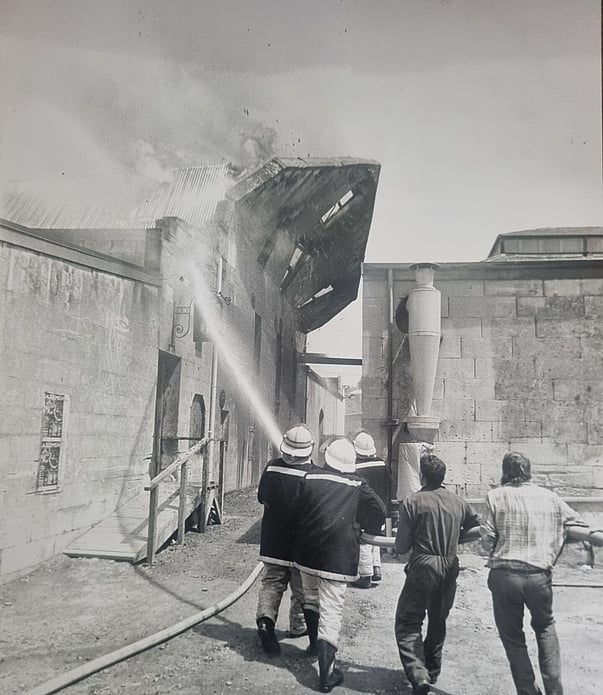
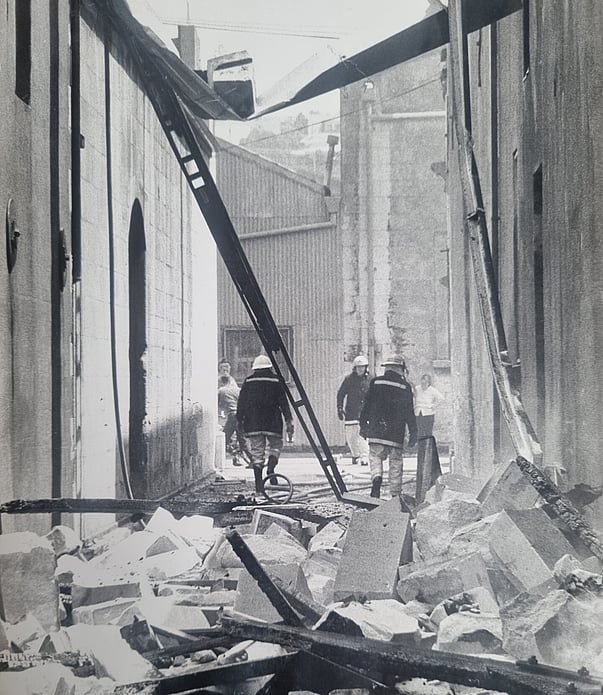
The Red Lion Mill, housed in the original 1875 concrete building, it was a prominent three-storey structure with a mansard roof. It was destroyed by fire in 1992, a loss widely regarded as one of the most significant heritage losses within the Heritage precinct in modern times.
Importantly, the original 1875 concrete grain store still survives today. It remains visible partway down the laneway, providing a rare and tangible link to the earliest phase of development on the site before Oamaru Stone was the favored building material
Trust History
Anderson's Store came into Trust ownership in 1989.
It was one of the first Trust buildings to have its frontage cleaned down.
The plans for the parapet for Anderson’s Store have been drawn, but the reinstatement of this parapet has not been completed